I had the pleasure of meeting Carri Graden today, who with her husband Travis, operate Cedarnook farms, a few miles east of my farm.
Carri Graden is very passionate about animal care and husbandry, and is not shy at all about sharing those views. She is also a strong advocate of the environment as well, which I've found to be the case in most of the small producers that I know. She is very vocal about issues related to runoff, manure and contamination of groundwater, and she has her hands full with her farm!
Carri has been an avid reader and commenter on my blog, and has spent time talking about my operation on other blogs, as well. I appreciate your attention, Carri, and I'm happy to return the favor. I'm looking forward to having many interactions with you in the next few years.
The land that Cedarnook farms is on, a 5 acre parcel in snohomish county, was purchased in 2007, at a cost of $405,000. I mention that because it speaks to how hard it is to farm here. Even land like Cedarnooks is very expensive. They paid $81,000 an acre for it, and as far as farmland goes, with the stream along one side there's the very real possibility that they'll be required to have a planted buffer area. Right now the agencies regulating this are talking about either a 150' wide buffer, or a 200' wide buffer, which, in the case of Cedarnook, would mean that they could not use more than half of their property, and that would probably be the end of this as farm.
Even though they purchased this land in 2007, Carri and Travis have had a long history in agriculture. In speaking with Travis he mentioned being associated with a Dairy -- which I have the highest respect for. Dairy farming is the hardest type, and there are darned few dairies left in Snohomish county anymore.
The salmon stream is the blue line at the top of the picture
the house is at the center, chicken coops are the white roofs at the top, center.
"buffer zones" seem like a good idea on paper, but they have a very real, and very serious, impact on rural land owners. By the stroke of a pen you can lose half your acreage. Most landowners hope that they can hide from the regulations by being rural, but as shown by the photo above, the county knows exactly where the streams are. The only thing we can do be vigilant and political and stop the regulations in the first place. It's not whether they will find you -- they already know. They'll just digest you in little pieces at their leisure.
When land is this expensive, its important to get the most use out of it that you can. Part of the acreage is a house, equipment area and a yard, leaving about 3.5 acres for the animals. Those acres are shared by 9 pigs, 2 horses, 4 beef cows and a large number of chickens. It's fenced and cross fenced, but the animals are allowed to wander around in the entire area and play in the stream.
Not pretty to the city folks
As with most farms, Cedarnook has the same sort of stuff that I do around my farm. The old stock trailer, check. Pile of wood, check. Random pile of brush, check. Most farms do. If you're a working farm you're going to have areas that just aren't pretty. Always nice to run across a kindred spirit.
As with my farm, Cedarnook has a challenge to deal with mud. At times I've thought that it was just me that had mud problems.
Looks like my farm
The problem with cattle is that their hooves cut into the sod much more than do smaller animals, and cedarnook has the same issues I do with trying to keep grass under their animals feet. This isn't the growing season - so any green that you see here is from last summer/fall. Once trampled in, it will be set back quite a bit in its growth next year. We all have different ways to manage our pastures.
Cedarnook has some really nice Hereford beef cattle. Here's one peeking at me
It's interesting to look at the challenges at different farms. Cedarnook is on a pretty substantial slope; the county maps show a 50' drop in 200' of pasture -- when you cut up the sod, there's a pretty good chance that you'll get some erosion. I don't have to deal with that on my property; it's about as flat as a board, but it adds to their challenge. The surface water management department will often force landowners to make stormwater ponds on their property to deal with potential runoff, further limiting the amount of land that can be used.
Springs mean you can have wetlands in the middle of your property. Bad news.
The other issue that they have is that there are springs in several areas, with flowing water. This is particularly troublesome in our regulatory environment. Each of these spring areas can be deemed a wetland, and be required to be fenced off, with a planted buffer around it. When you have a few acres, it doesn't take many "wetlands" to consume all of it. As I've found out in my experience with the Washington State Department of Ecology, there are no exceptions. If they deem it a wetland, its a wetland. In the middle of a pasture, on the edge, heck, even underneath a manure pit, as one homeowner found out when she tried to remove a manure pit to build a garage. Ecology deemed it a wetland and stopped the construction. I had to fight with them for 3 years about this, and finally settled that by giving them 25% of my land. I'd hate to see that happen here.
I recognize that
One thing that particularly reminded me of home was this. In the picture above you can see some globes...
Onions!
On closer inspection, they're old onions and oranges. I finally asked and yep, Cedarnook is feeding fruits and vegetables to their pigs, too. As you know from my writings, this is considered by the Snohomish Department of Health to be "improper disposal of solid waste". Part of the reason that I am fighting with them is to allow other small farms, like cedarnook, to use the food that would otherwise be waste.
A trailer of "solid waste" at Cedarnook farms. The rest of
us would call this food.
The only reason that small farms like this are able to do this is because they haven't been found yet, but that doesn't mean that they're safe. It just means that it's a matter of time before someone calls in a complaint. I don't know if Carri understands that, but I'm glad to be of service to her by resisting the regulators that would otherwise put her out of business. My fight is your fight, Carri.
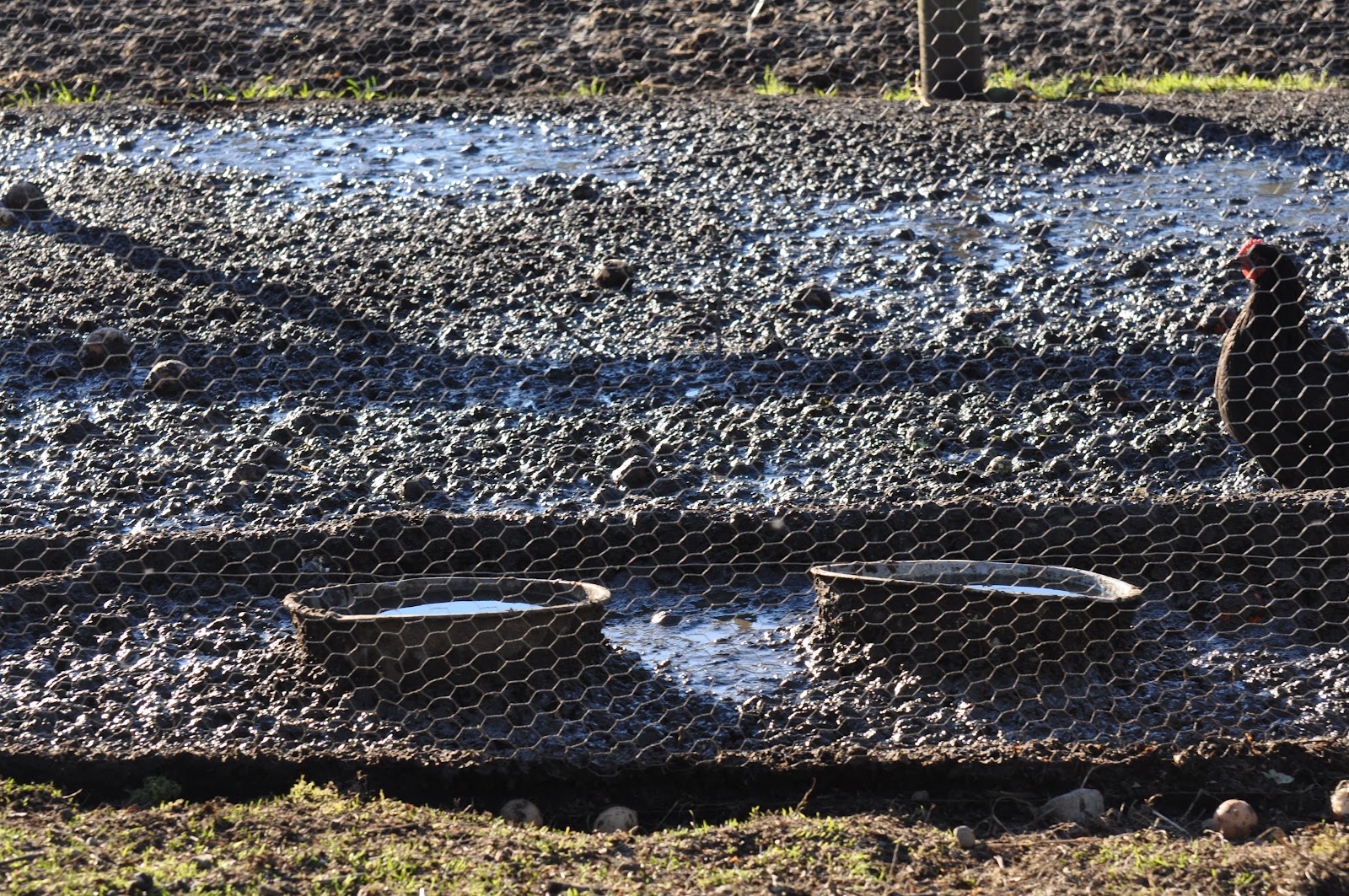
Carri does the same thing I do in freezing weather for chicken waterers.
It's funny, but even the chickens get some of the produce. The problem with feeding produce is that it makes the ground really soupy; I've had this very problem. When the chickens are walking through mud like this they get the eggs dirty, too. It's a pervasive problem.
Hi!
Cedarnook farms has a batch of weaner pigs that are about to be weaned. Here's a little guy looking up from rooting through the oranges and stuff. He's having a good, pig time.
A little Hereford gilt on the road, following us as we left.
Carri was a gracious host (you can see her above, on the right center, waving goodbye. One of her little Hereford pigs followed us as we walked up the road. It was pretty cute.
Small producers like Cedarnook are an example of where most of the pigs in this area come from. We've enacted a web of laws and regulations that make even small agricultural ventures like Cedarnook impossible. If all of the laws that are currently on the books were applied to the small farms in our area, we would not have any farms left at all.
Cedarnook farms is a small, diverse farm located near Snohomish Washington that is pretty close to my farm in all respects.
For more information on Cedarnook, you can find them at their link on
Local Harvest.




 Posts
Posts


