Saturday, May 21, 2011

All paths lead to cattle?

In the last month I've heard two different farms talk about the products they started with, and what they ended up with after a few years, and it seems like all paths lead to cattle. 

The Meat Chicken
  If you'd like to get into farming with the smallest possible investment, meat chickens are pretty much the way to go.  For about $150 you can buy all of the equipment  you need to raise them.  Here's the total list: 

  1 250 watt red heat bulb.  $15
  1 Clamp-style bulb socket (with ceramic socket) $10
  1 roll chicken wire, 50' x 24"  $25
  10 8' 2x4   $22
  1 plastic bin (for brooding chicks) $13

  The chicks and feed will cost you more, but you can easily do chicken tractor chickens for under $300 total investment, and on an average-sized residential lawn, even.  You don't need acres.   And you turn out a new batch of finished chickens every 8 weeks. 

...And that's really the basic problem.  Anyone with a couple of hundred dollars can be your competitor.  And the birds require daily care and feeding, and they're labor-intensive to process.  You don't have to have much in the way of equipment; a pot on the stove and a paring knife, and voila!  you're a pastured poultry producer!

Lets contrast that to Cattle.

The Beef cow
You go to the spring feeder auction and buy some yearly calves; probably $600-800 each.  You put each calf out on acreage, hopefully with some sort of water.  You provide salt block.  If your fences are tight and in good shape, well...

  That's it.  Until October. 

  ...yes, I know that beef guys are gonna give me some grief, but honestly, there's no way that a cow is as much work over the 7 months you feed it out as 4 batches of chickens would be, and considering that a cow produces the better part of a thousand pounds of hanging weight at the end of the year... 

It's all a matter of what you spend your time doing.  Cattle are popular if you're a big landowner because they're much much easier than most other livestock.  I raise both cattle and pigs, and I spend a lot more time looking after my pigs.  It's pretty amazing to me how little time I spend on my cattle.  Turn them out, look at their trough and fence every week or 10 days, and that's about it.  Yep, I could spend more time on them... but I don't have to.

I raise pigs as my primary crop because I like, enjoy pigs.  I think that they're neat animals, and I like the fact that the commitment to produce pigs is pretty big -- I don't need as many acres as beef producers do, but I do require more equipment to handle the tons of food and the collection of the tons of food. 
 

Wednesday, May 18, 2011

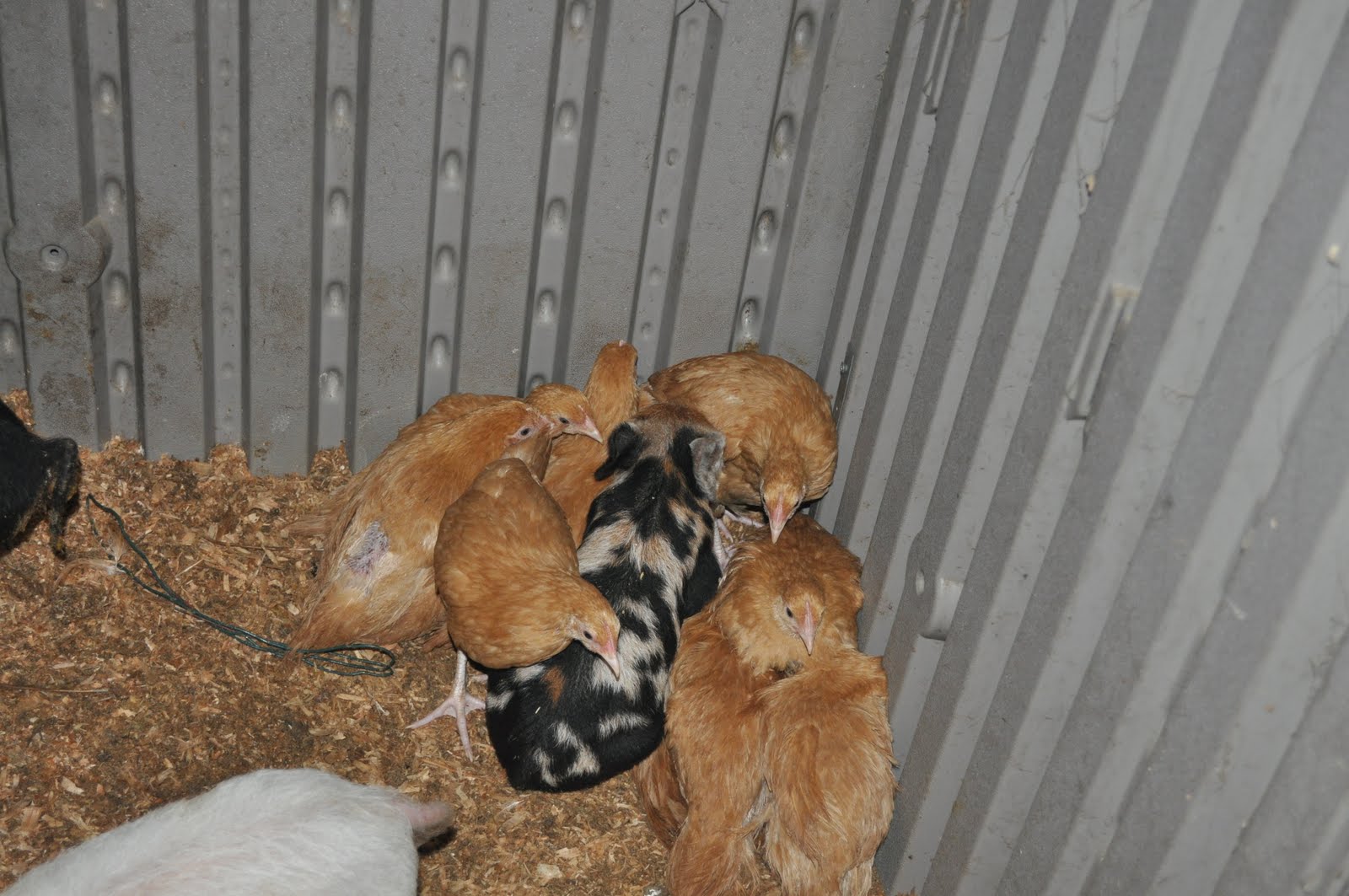
Piglets with a down jacket

 this little piglet went missing, and a quick search showed that it had made a bunch of feathered friends.  A piglet with a down jacket!

The chickens are buff orpington hens that we're raising as a replacement layer flock; everyone loves a warm friend when it's chilly outside. 

Tuesday, May 17, 2011

Feeding pigs meat

Why can't I feed my pigs meat? 

I got this question from a discussion that I was a part of on the web,  and it's something that I think bears discussion. 

Pigs on pasture will regularly go and eat whatever they can catch.  This means things like earthworms, grubs, field mice or slow farmers (kidding.  sort of.  )   They have a spectacular sense of smell, and I've seen them find things that are buried many feet under the surface, apparently by smell. 

So if you let a pig do what pigs do, their diet is as varied as they can make it, and includes as much meat as they can find; they enjoy it and seek it out. 

The two basic concerns for me are learned behaviours -- if they figure out that chickens are tasty, pretty soon I won't have any chickens -- and legality. 

The Washington State Department of Agriculture regularly interviews places that are generating large amounts of food waste and tracks that material to see if it's being fed to animals.  They do this particularly for waste streams that contain meat.  The issue is a concern about disease -- specifically, foot and mouth disease (FMD). 

The last US outbreak of FMD was in 1929.  Here's the quote: 

"...The US saw its latest FMD outbreak in Montebello, California in 1929. This outbreak originated in hogs that had eaten infected meat scraps from a tourist steamship that had stocked meat in Argentina...."

There are both federal and state regulations that cover the feeding of meat to animals, and the basic thing that you are required to do is boil the material for 30 minutes at 212 degrees.  Heating hundreds or thousands of gallons of liquid is expensive.  I don't know of any hog farms in Washington State that are doing that, but RC farms in las vegas, does, and for this reason. 

There are lots of small farms that do feed meat to their animals, and the regulations come into play most if you're selling the pigs, but the public health issue is worth considering as well.

Pigs aren't the only animals industry feeds meat to.  Milk replacer, fed to baby animals (cows, sheep, pigs) typically comes in two varieties -- a dairy based mix, and a non-dairy mix.  the non-dairy mix is usually made with blood.

For an example of the harm that foot and mouth disease can cause, take a look at what South Korea has been going through in the last 12 months.