Tuesday, December 16, 2008

Bad day at the farm - part 1

Pasture farrowing is new to me; it works pretty well in the summer; it's warmer and a little drier. Some folks seem to be able to farrow pigs in the winter -- like Walter Jefferies at sugar mountain. http://sugarmtnfarm.com/blog/2006/01/winter-farrowing-ideas-1.html


So this is my first winter farrowing on pasture. I have been following the sow for the last week, making sure that she was bedded with clean, dry hay... and I lost all 9 of her piglets today.

Some of these didn't make it out of their unbilical sacks, others did, but were found dead around the sow. The scientist part of me says that negative results are results, but it sucks when you're carrying a bucket of piglets.

I took pictures of the piglets, but after contemplating this, I've decided not to post them. There's nothing you'd learn from them, and for me, I'd like to forget today happened as quickly as possible.

I think in winter, I'll be switching to a farrowing pen for the first week or so of the piglets life, in a barn. After being cited, threatened, fined and paying various fees to snohomish county, they haven't granted me the permit that they required me to get, or told me that they will not grant it, so I cannot finish my barn that I started last year, and that sucks as well.

Snohomish county says they want to preserve and enhance farming, but my experience as the only new farmer in several miles in any direction is that they are hostile to any farming or any other activity. If my barn were complete I'd have someplace to put my steer, and someplace to put my other pregnant pigs. As it is, I'm stuck with a bucket of dead piglets and a steer that's likely to die, too.

bad day at the farm - part 2.

When I started this blog, I thought about whether I'd write about days that didn't go as planned. The day you wish you could just write off, or forget about. Today is one of those days.

My decision then was to write about the experiences because that's what I'd like to read. Farming isn't a disney picture; you take what you are given and do the best you can with it.

Today when I drove up, I noticed a cow down on the field. There's a patch of ice that formed, and in the recent cold weather (daytime highs of 20 degrees F, lows of 9 degrees F). Cows down are sometimes ok, but this cow was the middle of the patch of ice. It's not a very big patch of ice, but big enough, apparently.

The cow weighs between 300 and 400lbs, and is one of the largest of my $5 calves. I don't know how long it was laying on the ice, or what state its legs are in. I was able to move it to the side of the ice pretty easiily, pulling it over the smooth surface, but I couldn't get the animal to stand.

And I tried for an hour or so, pulling, lifting, tugging. This sucks a lot.

I finally brought the tractor over and rigged a sling with a load strap and the chain hook on the bucket.


Having lifted it it didnt' want to stand; the front legs look ok, but the rear legs aren't functioning. They may have been sprained, or maybe just frozen. Not sure.


I finally rigged a full-body sling for the steer out of a couple of supersacks, and suspended this little guy from the ground. he's about 18" above the ground and being held upright. He's eating and drinking, and has food and water in reach, but I fully expect to find him dead tommorow. really makes me want to spring out of bed, ya know?

Monday, December 15, 2008

Turkeys and pigs in snow

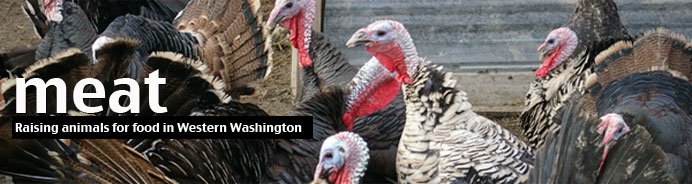
Sometimes you have to wonder if the turkeys can feel their feet at all. These heritage birds are standing in the snow -- there's bare earth all around, but the snow is apparently where it's at for a turkey. The center bird facing us is a bourbon red hen; the grey birds to the right and left are blue slate hens, and the bird in the center behind the bourbon red is a narragansett hen.


The turkeys at this time of year have split into two main flocks -- the toms and the hens. They spend a little time together, but for the biggest part of the day they're hanging out with their own gender.

The birds in the front here are narragansett, the rear birds are either black spanish or eastern wild. I keep a breeding flock of each type.
This is big mamma, she's one of my oldest sows and is currently pregnant; shes due around february. She's out for a stroll in the pasture.

This is her sister, Tank. She's still not farrowing, but any minute. Here she's moved the portable shelter we put out for her and is building a nest in the dry hay we provided. This means that we'll have to wait until she starts giving birth and then move the shelter on top of her, and give her another 4 or 6 bales of hay.


This is shorty; she's decided that she likes this shelter, and is making a nest of her own. My farm is bordered by a freeway -- that's the raised road you can see in the background. I have the most inspected farm in Snohomish county, Washington. 55,000 cars a day pass by, and during traffic jams, people spend a lot of time looking at my animals and operations. The most frequent question I get is how I get the pigs to respect the minimal electric fences I maintain.