Showing posts with label bourbon red. Show all posts

Monday, March 9, 2009

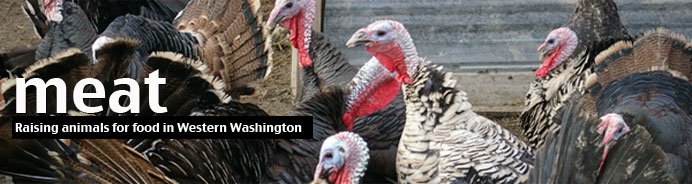
Bourbon red turkeys

The bourbon red turkeys have been popular with the livestock thieves this year. Maybe they read the reviews that said that bourbon reds were the tastiest heritage breed, or maybe they were just the slowest ones, but I've lost 6 toms and 7 hens. So I've penned the remaining bourbon reds far away from the road, and was happy to see them start laying today.

The hens weigh about 15 pounds and the toms around 20. They're pretty hearty and survive well here. When I started I purchased poults of 17 different turkey varieties. I've now settled on 7 varieties that I raise. For my farm, the eastern wild turkeys are the easiest to raise -- they pretty much fend for themselves and are excellent at foraging. In fact, they tend to teach the other turkeys how to eat blackberries and strip the seeds off the top of grass stems.

The bourbon reds are somewhere in the middle. They're fairly intelligent (for a turkey), docile birds with a nice color pattern. They're calm in disposition and are curious. The one thing about bourbon red turkeys is that they usually hate Andrea. Not sure why, but every year there's been two or three hens that have decided that Andrea should be chased, and they do chase her.

Saturday, January 31, 2009

Turkey breeding flock; farm calendar

Here's part of my breeding turkey flock. Click on the picture for a bigger version. There are blue slate, bourbon red, narragansett, eastern wild, sweetgrass and black spanish turkeys here. They're pretty fun to watch. At this time of year we're penning them by breed so we can get purebred poults. Turkeys can store semen for weeks, so it's important to have them separated for a while before you need purebred birds. In our case we collect the eggs as soon as we have them all penned and most of the (probably) crossbred poults produced will be our thanksgiving/Christmas birds. The purebred poults we'll sell to folks who want a particular type of heritage turkey, and some of those will go for the holidays, too.

I keep a large breeding flock because it's often impossible to find full-grown heritage turkeys in a timely fashion if you lose one. So having one tom is a mistake; you need at least 2. Having 3 hens is a mistake; you need at least 6 to make sure you have replacements in case of predators, accidents, or other mishaps.

I want all of my heritage birds for the holidays to be hatched by may; it takes 20 days to hatch a turkey, so the latest we'll set eggs for holiday birds will be the first week of April. Which means that we have Feb/Mar/April to collect eggs for this years Thanksgiving turkey crop.


The eggs that are layed from April to mid-may are the Christmas birds, and then the eggs that are layed in June are the replacement birds for the breeding flock. I keep a mixed-age breeding flock, with some first-year birds, some 2 year birds, and some 3 year birds.


I find that my survival rates for birds on pasture are better if there are some older birds to show the younger ones around.


The turkeys are bunched up like that because I'm working with the puppies on herding. Turkeys are a good practice animal for the pups because they can fly if they feel threatened but don't want to. Plus a turkey can, as a last resort, smack a dog pretty good with its wing. A smack or two and the pups learn to keep their distance -- the pups respect the turkeys, and the turkeys respect the dog.

Monday, December 15, 2008

Turkeys and pigs in snow

Sometimes you have to wonder if the turkeys can feel their feet at all. These heritage birds are standing in the snow -- there's bare earth all around, but the snow is apparently where it's at for a turkey. The center bird facing us is a bourbon red hen; the grey birds to the right and left are blue slate hens, and the bird in the center behind the bourbon red is a narragansett hen.


The turkeys at this time of year have split into two main flocks -- the toms and the hens. They spend a little time together, but for the biggest part of the day they're hanging out with their own gender.

The birds in the front here are narragansett, the rear birds are either black spanish or eastern wild. I keep a breeding flock of each type.
This is big mamma, she's one of my oldest sows and is currently pregnant; shes due around february. She's out for a stroll in the pasture.

This is her sister, Tank. She's still not farrowing, but any minute. Here she's moved the portable shelter we put out for her and is building a nest in the dry hay we provided. This means that we'll have to wait until she starts giving birth and then move the shelter on top of her, and give her another 4 or 6 bales of hay.


This is shorty; she's decided that she likes this shelter, and is making a nest of her own. My farm is bordered by a freeway -- that's the raised road you can see in the background. I have the most inspected farm in Snohomish county, Washington. 55,000 cars a day pass by, and during traffic jams, people spend a lot of time looking at my animals and operations. The most frequent question I get is how I get the pigs to respect the minimal electric fences I maintain.