Monday, December 29, 2014

Gun for killing rats. Lots of rats.

I've got a little hand-held thermal ocular.  It's a bit of military gear that has come in handy; if you want to see what it the display looks like, you can see a bit of it in this youtube video

What I use it for is quickly locating animals that are out after dark, or even in daylight; they stand out clearly from the (usually) cooler background, and it makes finding the cow after dark much easier - you can spot a cow-sized animal from hundreds of yards away, even through vegetation, and it's made it possible for me to watch a lot of wildlife that is otherwise hard to follow -- coyotes after dark, for instance.
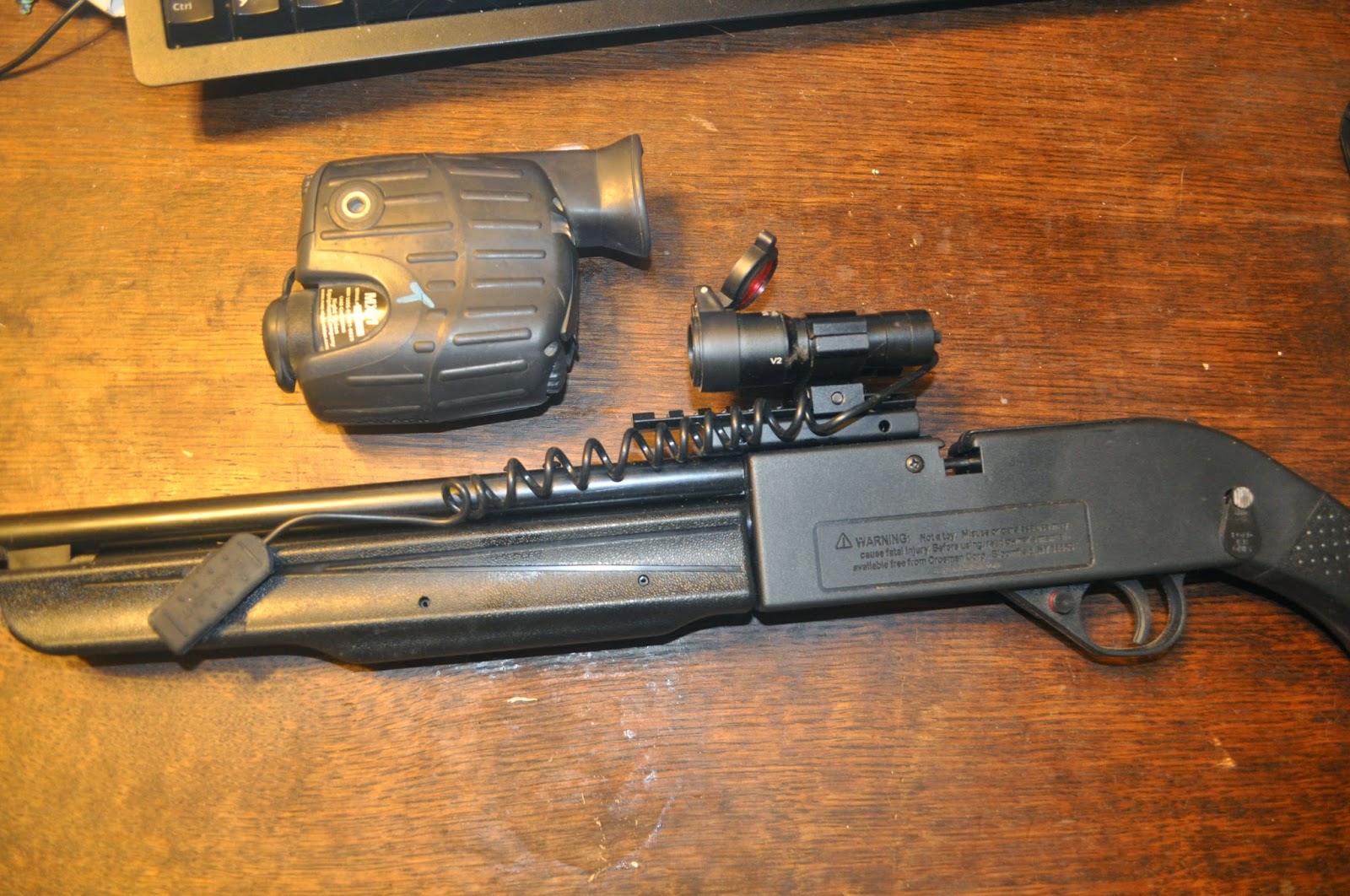
My rat killing setup

Walking around the farm after dark, the thermal ocular is showing me I have a large population of norway rats.  They're grey with white bellies, and they get pretty big.  They think that they invisible after dark, and it's possible to walk right up on them, and that's where the BB gun comes in.   I dont' want to use poison for fear of one of my dogs eating a poisoned rat, and I don't want to use lead-based ammunition out of the same concern.

I wanted to be able to kill the rats with the least-cost possible as far as ammunition, and the smallest chance of over-penetration -- which is the complicated way of saying I don't want the ammunition to go very far past what I'm shooting.

So the selection was for a pump-action BB gun that shoots steel BBs.  Each BB cost about a third of a cent ($0.003) and being steel, there's less issue with it being ingested by the animals than with a lead-based shot.  The cows have magnets that will collect them if th ey eat them, and they'll just pass right through pigs.

The next problem was that in the low-light situations I couldn't see the sights to be able to aim the gun.  the solution was to purchase a cheap laser-flashlight combo (you see it mounted on top of the rifle) that comes with two pressure switches.   You velcro the switches where your hands are when you aim the rifle, and you can swith on or off the flashlight or laser.  20 minutes sighting the laser in (I chose to sight it at 30' because that's the longest shot I would make, and the BBs from a smooth barrel aren't all that accurate) and I have my basic rat killing setup.
laser/flashlight combo packaging.  
The BB rifle has a 3/8" mounting rail for scopes, and I bought a converter from 3/8" to 20mm Weaver Picatinny rail mount.  I did that because I could get cheaper laser/flashlight combos that mounted to the 20mm rail than I could for the 3/8" rail.  the adapter was about $8.

the laser/flashlight combo was $27; the bb rifle was about $60.  So the entire gun setup purchased new totaled $95.  6,000 BBs cost $20.

The basic technique is pretty simple:  Pump up the rifle and load a BB, and then using the thermal site walk to within about 10' of the rat.  Put the ocular in a coat pocket, aim the rifle, flip on the laser site red dot, aim the rifle where the rat is, and then flip the flashlight on  The rat will usually freeze when hit with the light - zap! - bb hits rat, off the light goes, pump the gun up, and look for the next rat to kill.  

The first night I killed 9 rats, the second 12 rats, the third 8, and then I've killed 5 to 10 rats each night since then.   They started hiding in their holes, but they usually sit with their heads sticking out about an inch so that they can see what's going on, and that's plenty for me.  The thermal site shows me which holes have rats - flash, zap! dead rat in hole .   I can count the number of rats with the thermal site (I can see them for hundreds of feet as bright white blobs) and I have about 200 or so that live in or around the barns.  The thermal site also makes it easy to hunt them in the rafters and along the beams of the barns.  They'll usually just freeze up there, spotlight, shoot, rat falls, move on.
I'd sure love to be able to own a thermal rifle site for this.  In my dreams I'd put it on a semi-auto pellet gun sighted for 50', and since I wouldn't have to show any light at all, I could probably shoot 5 or 10 rats at a time without them h aving any clue I was there - but I can't justify the $3 to $5k for the site.  But they sure are cool.

Back to the future

Way back in 2006 a local celebrity chef wrote a blog about raising four pigs and then slaughtering them and serving them; you'll find Ms. Murphy's blog in its entirety here

She raises 4 pigs over the course of a few months to a slaughter weight of around 100lbs.  Now for me, that's a light slaughter weight -- we sell pigs for consumption at that weight, but we call those BBQ pigs and they're usually spit-roasted whole.
A more traditional use of a light pig

Ms. Murphy procured her piglets through whistling train farm, who seem to have gotten out of the pig business for the most part since this article.   They apparently have a single sow that they breed for piglets at this point, but somewhere between 2006 and here they had 6 sows at a high-water mark.
What's interesting about this to me is that I started farming in earnest in 2007, and the market for piglets has been great every year since then.  So it's not that they couldn't sell all the piglets they produce, it appears that  Whistling train  focused on vegetable and egg production as their primary products.

In the second-to-the-last entry of Tamara's blog she talks about the slaughter day, and I'm left with the impression that she didn't witness the slaughter of her pigs, choosing to spend the kill time in the office - here's the quote:

"Shelley, Mike and I went into the office for the business part of the day. They said it would be fine if we went into where they were working.  After all, they were our pigs.  We were in the slaughter house aproximately 15 minutes after we arrived, and the pigs were already being put through a machine to clean and remove the bristle "

Which I am a little dissapointed at.  In her last entry she talks about her emotional attachment to the pigs as she breaks them down, and says something about having taking pictures, and honestly this is the real crux of pig farming for me, personally; I'm sorry that she didn't follow it through.

In my own farming I choose to shoot and stick the pigs that we sell whole to customers to make sure that the pigs have the respect due to them, and that it be as quick and painless as possible.  It's not a chore I relish; but it's part-and-parcel of raising animals for food.   Yes, I can delegate that, and I do for those folks who want to go the cut-and-wrap route with a whole or half pig, but for the small, the old, and the traditional, we take care of this right here.

For the same reason I don't sell my old boars at auction -- the herd sires that are past their prime are treated with all due respect, and given a quick clean end right here where they lived.  It's unfortunate, but when you dispose of animals at auction they can meet their end in many different ways.  I'll forego the profit to ensure that all of mine end respectfully.

Tamara Murphy is sort-of a neighbor mine, too.  A local farm was purchased by a non-profit group, and the acreage was converted into wetlands and other projects.  Tamara coordinates/hosts an annual BBQ as a fundraiser, which is very popular but the farm itself seems to be withering on the vine; I just don't see much from them recently, other than the BBQ fundraiser.

It'd be interesting to see what she's doing 8 years later -- is she still raising her own, or sourcing her meats from local resources?   There's no clue on her latest menu. - yes, it says that they source ingredients from local growers and artisan producers,  but how about you support the farmers in a more concrete way by mentioning the source?    I'm sure your customers would like that, too Tamara.
And if you're looking for local pigs, I'd be happy to set you up.  Give me a call sometime.


Tuesday, December 23, 2014

The 2015 farm plan

This is the sketch of the plans for 2015.  

The cow herd  
Going to increase my dairy herd by 10 cows this year, from 20 to 30.  Hopefully finding some good heifers in the 300 to 600lb range.  This set of cows will probably be the last that i purchase -- from next year on the normal calf production should cover my replacement animals and produce steers for sale as meat, so I'll be set there.    We are carrying 7 steers now, and I'll sell those as grass fed cattle in 2015.  

I'll be certifying the whole cow herd as organic, so I'll start that process in 2015 and we'll be organic about the same time as the pastures are certified. 

The pig herd
The pig portion of the farm continues to be a strong earner; margins are good, and we're still selling every animal we produce at a good price.   The primary emphasis for the farm will continue to be weaner pig sales.  I'm increasing my sow herd by 20 in 2015, and I'll be reserving a larger percentage of our weaner production for sale as finished animals.  

The land
It takes 3 years to have pastures and planting land certified organic; i'm on the 2nd year of that.  I'll be able to be certified organic in 2016, with will coincide with the start of commercial milking. 

Forage and crops
The alfalfa and orchard grass production was good last year, and the stands look to be in pretty good shape going into winter.  We'll see if the alfalfa survives the rains, but I'm sure that the orchard grass will.  We'll aim at producing another 100 to 150 tons of forage this coming year.  I will probably buy an accumulator and bale grab to reduce the amount of labor needed to pick up the bales in the field.  

I'm going to grow more human vegetables this year; I was happy with the size and quality of the acorn squash and various types of pumpkins grown, this year I'd like to experiment with plastic mulch so that we can keep the weeds down and continue to grow organically.  

House and barns
Bluntly put, the house on this farm sucks.  It's a typical farm house, which means that every time they had a good year they added another room to the house, so that it ended up being a giant L shaped house that is basically one long hallway.  Each room has a door on either end, and you have to pass through every room in the house to get from one end to the other. 

I'm probably going to work on making the house more livable by moving some doorways and doing other modifications so that it works better.  I've already rebuilt one of the entrance porches, and I'll be added a roof over each doorway.  Long term I'd probably be better off to just save some money by doing nothing and tearing the house down and starting over, but for the next few years I'd like it to work better, so I'll do a little towards that.  

On the barn front, all of the gutters on the barns need to be repaired and the clean water off the roofs directed away from the livestock housing.  It'll probably mean figuring out a system of drains and an outlet somewhere.  This is partly due to regulation - dairy farms are required to do this - and partly due to liveability.  We get 5 to 8 feet of rain a y ear, and the gutters are dumping the roof water all over the driveways and walkways and so on, and it makes the ground soft and muddy.  

I'll also be looking seriously at a couple of the barns for either replacement or repair.  There's a fair bit of rot and damage, each building is a seperate case.  Next spring I'll go through each building and make a punch list and figure out the plans.  

I'll be tearing down and rebuilding the wellhouse on this property, and installing better water filtration for drinking water for staff and house.  The well water here is high in iron and calcium, and has a little bit of manganese and arsenic in it.  Tolerable, but I'd like to have better water, so a new wellhouse will make the installation and maintenance of the water system easier, and bring it above any likely flood level.  the current wellhouse flooded with 2' of water in the record floods that they had on this property in 2010.  

Towards the end of 2015 we'll be putting the dairy parlor back into commercial shape and having it certified as a grade A dairy again.  it's been certified in the past; it's just a matter of getting everything cleaned and repaired and approved.   We don't need any new equipment, but may need to repair some of it.