4 weeks ago
Sunday, August 8, 2010
Building a corral
(This tractor-mounted auger makes this easier than digging it by hand, but not much!)
I built a corral at my cow pasture last year (part 1, part 2, part 3, part 4, part 5) to allow me to load/unload the cows and work with them as needed. Cows that are grazed are not tame, and having a secure, fenced area and good loading facility means that I can use the property more efficiently, and more important, reduces the chance of injury to me or to the cows. A properly built corral means that one man can safely load a trailer of cows in a pretty short amount of time.
This corral is being built to allow me to work on every type of animal i keep in quantities; pigs, sheep and cows. So the measurements are a little different -- pigs are just as wide as cows, but much shorter, sheep are much smaller than pigs or cows -- but the basic functions will all be there. I'm going to incorporate a livestock scale and squeeze chute into this design. What I'm after is to be able to better manage my herd and track growth and weight more easily. With a proper setup, weighing the herd gets a lot easier -- one way to do it is to train the animals to get to food. After a few repetitions, they'll line up for the trip.
The basic timbers I'm going to use are 6x8" 16' long posts for the gate posts, and 6x6x10' posts for the fence posts. for the rails I'm going to use 2x6 lumber, and I'll coat all of the boards that aren't pressure treated with preservative before they're mounted.
The reason that I'm going larger on the timbers is that the last corral I built with 4x4s, and it just isn't sturdy enough. the bigger posts do raise the material costs about 20%, but sturdy is what I'm after, particularly if I'm having to deal with agitated animals that weigh 800 to 1400lbs, as I might if my farm floods.
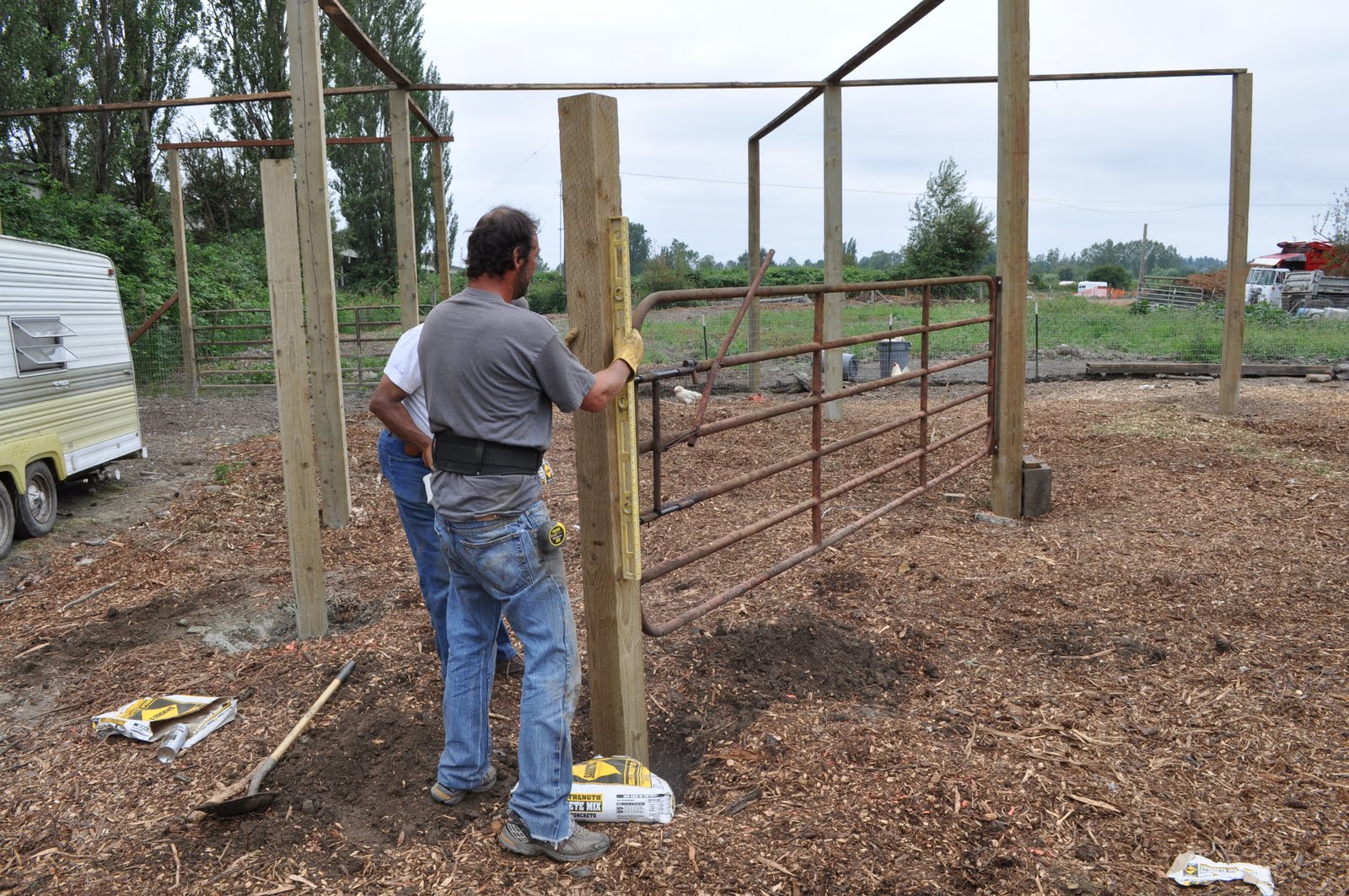
The big difference between this time, as far as the actual construction goes, is that I planted the post with the crowding gate, which is used to move animals into the loading/handling chute. By placing this post first you can use the gate swing to plant all of the other posts in the radius turn. Here, the post is in a hole and is being positioned and leveled before it's concreted in.
what I'm after is a fit for the gate that looks like this. Inside this post there will be 2x6 rails covered with 3/4" plywood for a visual barrier. The long spikes that form the gate latch will go through all of that, providing a positive latch. each of the posts, at 8' intervals around the round edge of this crowding tub, will provide a "ratchet" -- you herd the animals in, and then use the gate to follow in behind them. As you move foward with the gate you can latch it at any point to prevent the animals being chuted from pushing it open.
each of these posts will either be a latch for a gate, or the post that the gate is mounted to. the overhead boards prevent the top of the post from moving in any direction. The posts are 6x8s, the overhead boards are 3x8s which I cut in my sawmill. To allow easier tractor access, the majority of these gates used for this corral are 16'. I purchased all of the gates used, off craigslist. They're really nice, heavy steel gates, but need a well secured post to make them swing correctly. Each post has 6 80lb bags of concrete anchoring it.
Saturday, August 7, 2010
Lost a ewe today
Found one of my young ewe lambs today. the area I found it in was a pig wallow last year, and is pretty soft. Either the sheep was chased into the mud and got stuck, or it got stuck and then something started eating it.
When I found this sheep it was still alive; the spinal cord had been chewed through halfway down the back, and the right lung was punctured. you could hear the breath going in and out of the sheep. I looked carefully at the wound and then went and got the rifle.
I looked at the mud carefully, hoping to figure out what had done this. There were no distinct prints. There also wasn't enough of the sheep eaten to call it a coyote attack,and no sign that the sheep had been dragged -- no marks on the neck or head, which is usually how a coyote drags it. After looking at it for a half hour, I believe that this sheep got stuck in the soft mud, and some sort of bird started eating it. Maybe a vulture or an eagle, or a red tail hawk, all of which are in this area. It just doesn't look like a canine predation scene.
On the husbandry side, I'm going to have to fill this hog wallow in. It's clearly a deadly sheep trap.
When I found this sheep it was still alive; the spinal cord had been chewed through halfway down the back, and the right lung was punctured. you could hear the breath going in and out of the sheep. I looked carefully at the wound and then went and got the rifle.
I looked at the mud carefully, hoping to figure out what had done this. There were no distinct prints. There also wasn't enough of the sheep eaten to call it a coyote attack,and no sign that the sheep had been dragged -- no marks on the neck or head, which is usually how a coyote drags it. After looking at it for a half hour, I believe that this sheep got stuck in the soft mud, and some sort of bird started eating it. Maybe a vulture or an eagle, or a red tail hawk, all of which are in this area. It just doesn't look like a canine predation scene.
On the husbandry side, I'm going to have to fill this hog wallow in. It's clearly a deadly sheep trap.
Friday, August 6, 2010
what on earth am i feeding my pigs?
One of the questions I get pretty regularly is what I feed the pigs. Here's today's menu: Surplus/expired/wilted produce. As you can see, it's a mix of all sorts of vegetables and fruits. Pineapples, watermelons, corn, oranges, papayas, apples, and basically every other type of fruit or vegetable you'll find at a supermarket.
The pigs pick through the produce and eat what they want, the rest gets mixed with wood chips and then composted. I particularly like this sort of feed because otherwise this stuff would hit the landfill and be lost. I get 30 to 60 yards a week (a dump truck is 10 yards) of this, and it really helps to keep the feed bill lower.
Subscribe to:
Posts (Atom)